





ScaleTrains N
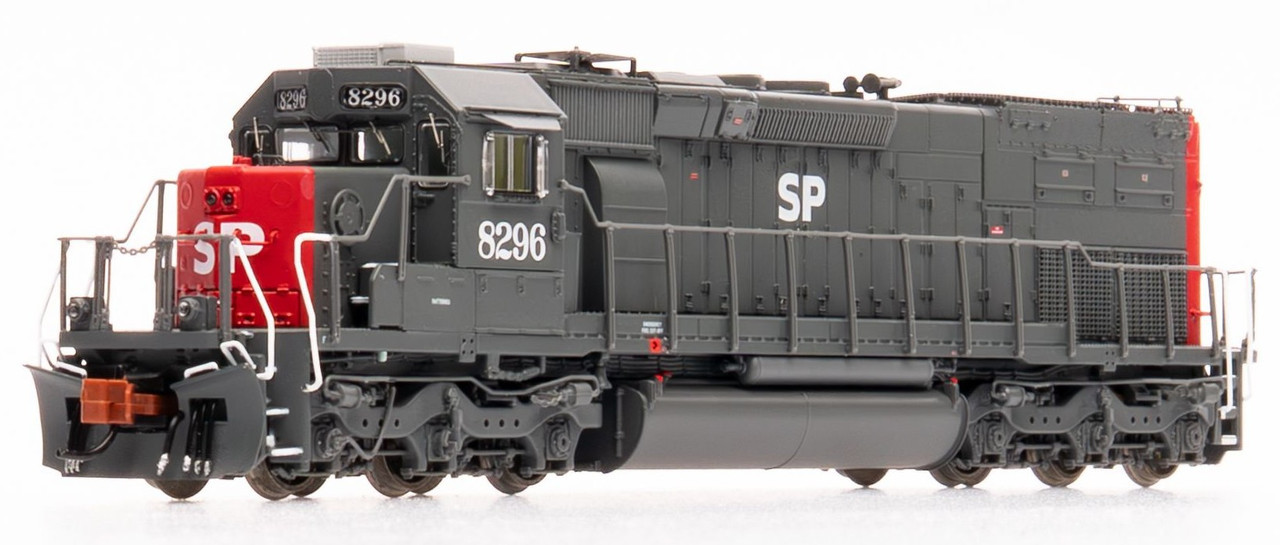
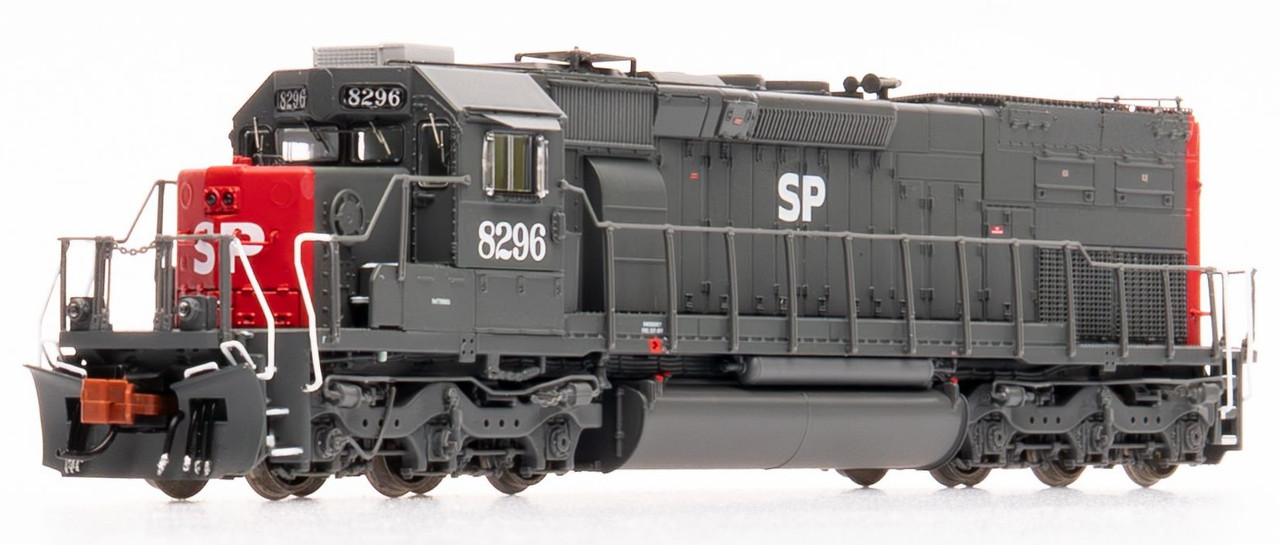
ScaleTrains Rivet Counter N SXT41067 DCC Ready EMD SD40T-2 Southern Pacific "SP" Lettering w/Ditch Lights SP #8259

- In Stock:
- 2
- Scale:
- N
- SKU:
- SXT41067
Description
Please note picture is representative of the item but may not be same road number. Always refer to product description for actual product details.
ScaleTrains Rivet Counter N SXT41067 DCC Ready EMD SD40T-2
Southern Pacific "SP" Lettering w/Ditch Lights SP #8259

Road Number Specific ScaleTrains
- New paint scheme
- Era: 1999 to Early 2000s
- SP Series 8230-8299, built 3-4/80
- Road numbers 8259 and 8296
- Painted in 1999 at the Roseville Shops in a Simplified SP Scheme
- Fully-assembled
- Multiple road numbers
- Operating LED-illuminated front deck-mounted ditch lights*
- Removed and blanked front and rear red Pyle-National 17540 “UDE” Gyralites
- Blanked class lights with gaskets on front and bolted plates on rear
- Printed and LED-illuminated number boards*
- Vapor Corp. cab roof HVAC
- Front late SP/UP-style pilot plow with MU hose doors and grab irons
- Front and rear 3-hose MU hose clusters with silver gladhands
- Body mounted knuckle couplers; Micro-Trains compatible
- Coupler box accepts Micro-Trains 1015/1016 couplers without modification
- Front pilot anticlimber
- Scale sectioned treadplate detail on the walkways
- Front "tall" stepwells and rear “ladder” steps
- 88” low short hood with wheel handbrake
- Bolted battery box doors with wide louvers
- Late cab sub-base doors with lift-off hinges
- SP nose headlight package
- Dash-2 cab with welded side window panels, SP/SSW blue flag bracket, and modified “L” front window
- Cab front door with additional door lock at top of door
- Tall clear wind wings with angled top corners mounted fore and aft of cab side window on both sides of cab
- Rear cab side vent on left side
- Standard EMD sunshades and long sunshade tracks
- Lost-wax brass Leslie RS-3L-R three-chime horn on clearance bracket, relocated to long hood roof
- “Whip” radio antenna mounted on ground plane over dust bin
- Late electrical cabinet "zig-zag" seam, closer to rear of cab
- Welded ECAFB (late)
- Late inertial air intake grilles with top and bottom drip rail
- “Post 1980” exhaust stack with silencer
- Accurately-profiled "post-1980" extended-range (bulged) dynamic brake housing
- Front straight uncoupling levers with loop handles and two inner and two outer mounting brackets
- Straight rear uncoupling lever with four mounting brackets
- Handrail set with anticlimber front and rear end railing with outward facing mounting brackets, “breakaway” inner stanchions and chain
- Notched pilot faces with high mounted angled lifting slots
- Pilot-face mounted MU receptacle
- Detailed cab interior with separate floor, rear wall, seats, and standard AAR control stand
- Accurate hood door and long hood detail
- See-through standard 48” dynamic brake fan housings with fan blades visible inside
- See-through radiator intake compartment
- Etched-metal radiator exhaust grills with radiator shutters visible underneath
- Underbody frame rail with separate plumbing and traction motor cables
- Detailed HT-C trucks with Hyatt bearing caps, late center axle snubbers, sanding lines and brackets (outboard only
- Speed recorder first axle, left side
- Four-hole SP jacking pads
- Spare knuckle holders on rear pilot face
- Sill-mounted EFCO
- Frame-mounted bell
- Double Graham-White (Prime) brand 975-075 (can style)
- Standard air tanks
- 4,400 gallon fuel tank with reinforced tank edges where sides meet the tank ends, dual fuel fillers, dual vertical gauges, round gauge on stand and vertical breather pipe
- Factory-applied wire grab irons, windshield wipers, trainline hoses with silver gladhands, and more
- Motor with 5-pole skew wound armature
- Dual flywheels
- All-wheel drive and electrical pick-up
- Directional LED headlights
- Printing and lettering legible even under magnification
- Operates on Code 55 and 80 rail
- Packaging safely stores the model
- Minimum radius: 9 3/4”
- Recommended radius: 11”
DCC & sound equipped locomotives also feature
- ESU LokSound 5 DCC & Sound decoder with “Full Throttle”
- One (1) cube-type speaker
- EMD 16 Cylinder 645E3 prime mover
- Operates on both DC and DCC layouts**
DC/DCC & sound ready locomotives also feature
- Operates on DC layouts**
- DCC ready with E24 connector
* Lighting features operate when using an ESU decoder with appropriate programming while operating using DCC
**Lombard Hobbies Recommendation - As modelers ourselves we highly recommend ONLY running DCC on DCC systems and DC on DC systems, regardless of 'Dual-Mode' capability. This gives optimum performance and safeguards the unit from possible damage from running on a different system than originally intended and from any inexperienced operator errors.
Prototype History
Due to their rugged operating environment, stretching from the Pacific coast to the Sierra Nevada, to the deserts of the Southwest, Southern Pacific Railroad, and its subsidiary, the St. Louis-Southwestern (aka Cotton Belt), weren’t shy about ordering specialized equipment. The famed AC-series “Cab Forward” articulated consolidation steam locomotives were one example, designed with tunnel and snowshed operation in mind. Partway into SP’s diesel era, the tunnels and snowsheds common on the western half of the system would again prove to be an operational headache, thanks to locomotives overheating during long pulls in their cramped confines. Once they overheat, thermostatic controls would automatically make the unit reduce its output, or even shut down altogether, resulting in a loss of horsepower that may be enough to stall the train.
SP and EMD would collaborate on finding a solution to the problem. One idea that was tested in the late 1960s was “Elephant Ears”, large sheet-metal airfoils, applied to the radiator intakes of various members of SP’s large SD45 fleet. While effective at their intended purpose of directing a greater volume of cooling air towards the radiators, and reducing overheating problems, they were a maintenance hassle that blocked easy access to numerous hood doors. Engine crews also disliked them, as they could impede the walkways. A more permanent solution would be found in 1972, with the delivery of the first SD45T-2 to SP. Cataloged by EMD as an extra-cost option of their basic SD45-2 … “SD45-2 with cooling system modifications”, as described in EMD product manuals from the early 1970s … the SD45T-2 built upon the basic principle of the elephant ears, but in a permanent package. The modified radiator system, with large intakes mounted near the walkway level, was designed with more efficient cooling in mind; in particular, faster recovery between tunnels and snowsheds. A success, SP would order a “T-2” variant of the SD45T-2s cousin, the SD40-2.
For the SD40T-2, the basic SD40-2/45-2 frame was stretched several feet to allow for an enlarged radiator compartment at the rear of the long hood, similar to what was done for the SD45T-2. Instead of the traditional placement of the radiator fans on the long hood roof, above the radiator cores and intake grills, the T-2 design placed the radiator fans and a diffuser assembly inside of the hood, below the radiator cores, and above a large, open radiator intake area placed at walkway level, resulting in faster, more efficient cooling. SP 8300, built in 1974, would be the first SD40T-2, whose fuel-efficient sixteen-cylinder 16-645E3 prime mover would prove to be more popular than the thirsty twenty-cylinder 20-645E3 used in the SD45T-2.
And of course, the units would be equipped with SP’s traditional Pyle-National “Gyralite” signal light package; while the SP 8300-8306, 8350-8356 only had signal lights on the front, changes to signal light policy saw all subsequent orders equipped with these safety appliances front and rear. The dual clear Gyralite assembly was intended to supplement the standard dual sealed-beam headlights as an attention-getter for motorists and pedestrians, while the single red-lensed Gyralite was meant as a safety feature for other trains. Tied into the brake system, when brake pressure dropped, as might happen when brake lines parted in a derailment or other mishap, the red Gyralite would automatically illuminate, extinguishing other headlights in the process, as a warning to trains on adjacent tracks that the train was in emergency, and to be wary of derailed equipment possibly fouling the tracks. The red light could also be activated manually, to act as a marker light.
Popular with engine crews and maintenance forces alike, the SD40T-2 would form the backbone of the SP and Rio Grande locomotive fleets well into the 1990s. Physical changes would appear to their fleets over the years; as a cost-cutting measure during the mid-1980s, as SP was struggling during an economic downturn, as well as the failed SPSF merger, the distinctive Gyralite signal lights, with their electric motors and moving parts, started to be removed, replaced by Prime Stratolite “digital” rotary beacons on the cab roof, which featured no moving parts to maintain. Also deleted were the expensive engineer’s side “L” front cab windows, replaced by cheaper, more standardized pieces of impact-resistant glazing.
Into the 1990s, the SD40T-2s soldiered on. In 1991, the SP “Speed Lettering” paint scheme was introduced, with elements taken from both SP and Rio Grande. With a backlog of tired units needing overhauls and fresh paint, only a relatively small number of SP and Rio Grande SD40T-2s would be repainted into the striking new livery, but they looked sharp amongst a sea of grungy locomotives. While the new livery showed promise for a railroad that had struggled throughout the 1980s and was seemingly getting back on its feet in the 1990s, it was to be short-lived, as Union Pacific would acquire Southern Pacific in 1996, with the merger taking effect on 9-11-96. As with past merger acquisitions, UP quickly absorbed the combined SP/SSW/DRGW SD40T-2 fleet, with many receiving coats of UP Armour yellow and gray. Others would receive new UP-system numbers in the form of a “patch” over their old numbers.
Lombard Hobbies - Your #1 Largest Authorized ScaleTrains Retailer!
0 Reviews Hide Reviews Show Reviews
Related Products


ScaleTrains N
ScaleTrains Rivet Counter N SXT41069 DCC Ready EMD SD40T-2 Southern Pacific "SP" Lettering w/Ditch Lights SP #8296
Please note picture is representative of the item but may not be same road number. Always refer to product description for actual product details.


ScaleTrains N
ScaleTrains Rivet Counter N SXT41066 DCC/ESU LokSound V5 EMD SD40T-2 Southern Pacific "SP" Lettering w/Ditch Lights SP #8259
Please note picture is representative of the item but may not be same road number. Always refer to product description for actual product details.

ScaleTrains N
ScaleTrains Rivet Counter N SXT41068 DCC/ESU LokSound V5 EMD SD40T-2 Southern Pacific "SP" Lettering w/Ditch Lights SP #8296
Please note picture is representative of the item but may not be same road number. Always refer to product description for actual product details.


ScaleTrains N
ScaleTrains Rivet Counter N SXT41065 DCC Ready EMD SD40T-2 Union Pacific 'ex-SP "SP" Lettering Patch' w/Ditch Lights UP #8852
Please note picture is representative of the item but may not be same road number. Always refer to product description for actual product details.


ScaleTrains N
ScaleTrains Rivet Counter N SXT41030 DCC/ESU LokSound V5 EMD SD40T-2 Southern Pacific 'Distressed Roman Lettering Lobotomized' SP #8560
Please note picture is representative of the item but may not be same road number. Always refer to product description for actual product details.