


ScaleTrains N
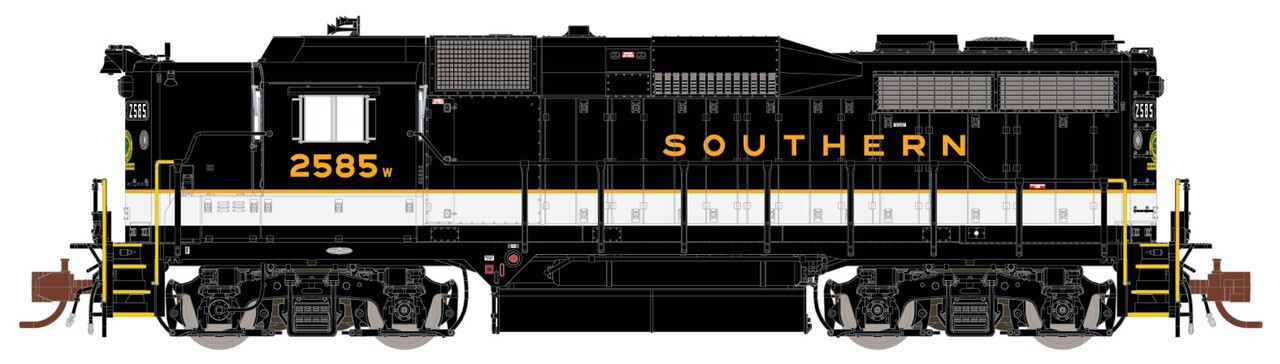
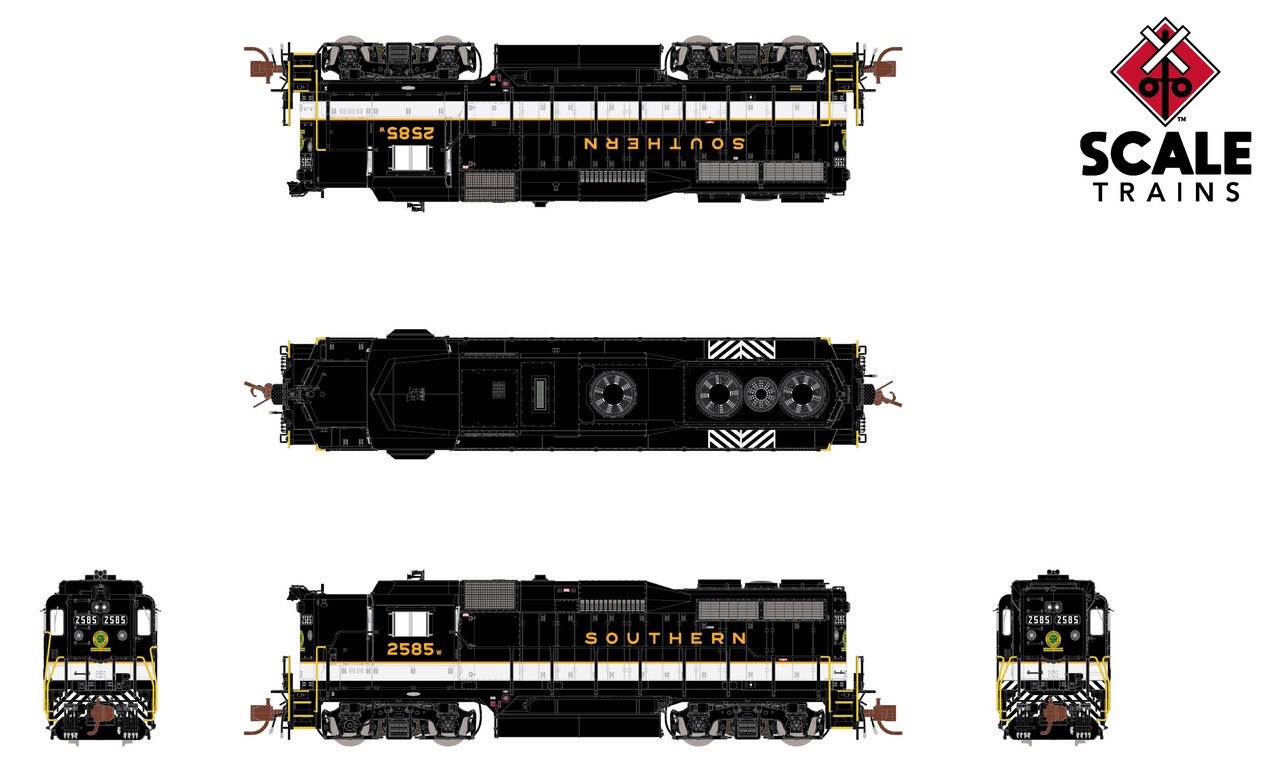
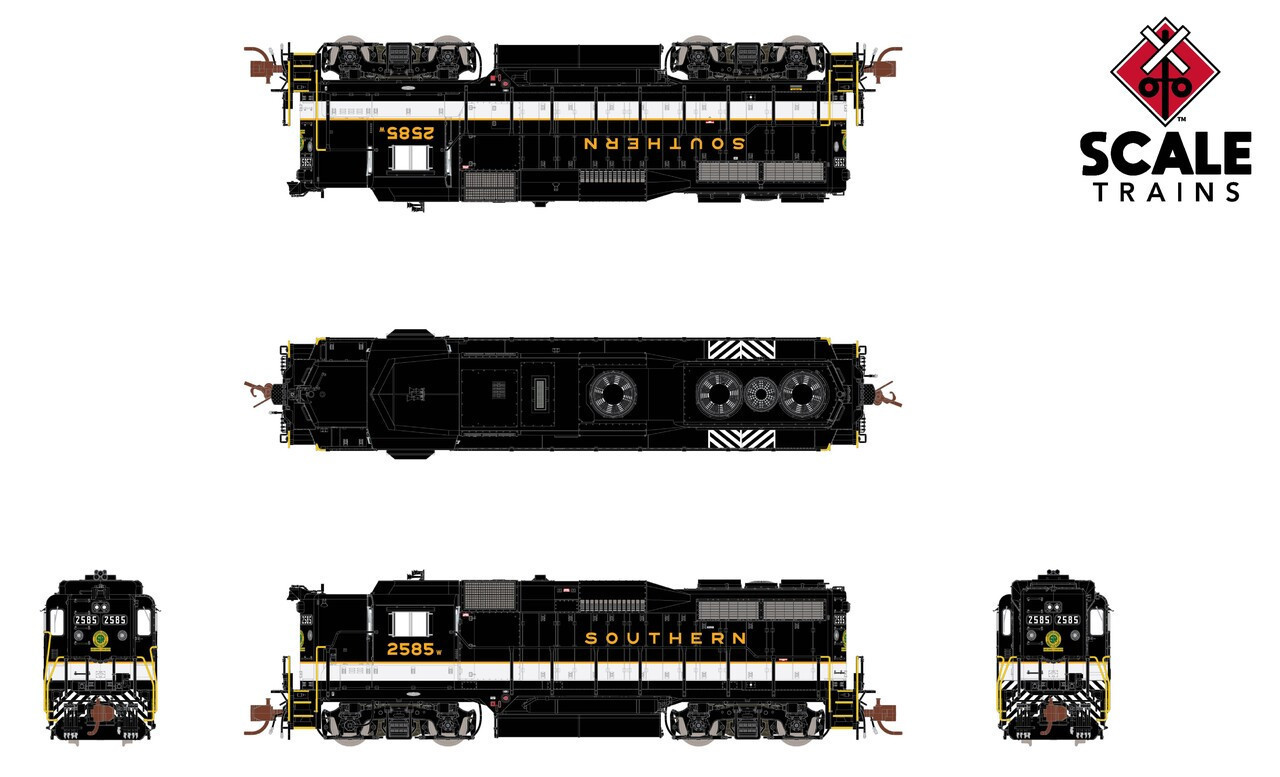
ScaleTrains Rivet Counter N SXT39988 DCC Ready EMD GP30 Locomotive Southern/Dulux "Partial Barricade Striping" SOU #2592

- In Stock:
- 4
- Scale:
- N
- SKU:
- SXT39988
Description
ScaleTrains Rivet Counter N SXT39988 DCC Ready EMD GP30 Locomotive
Southern/Dulux "Partial Barricade Striping" SOU #2592

Road Number Specific ScaleTrains
- All-new model
- Series 2585 to 2644; built 9-10:63
- Road number 2585, 2588, 2592, 2596, and 2606
- Era: 1970s to 1980s
- Fully-assembled
- Multiple road numbers
- Directional LED headlights
- Class lights (non-operating)
- High short hood mounted lost-wax brass cast bronze bell
- Printed and LED-illuminated high short hood and rear number boards*
- Front and rear multiple unit (MU) hose catch bars
- 4-hose multiple unit (MU) hose clusters with silver gladhands
- Body mounted knuckle couplers; Micro-Trains compatible
- Coupler box accepts Micro-Trains 1015/1016 couplers without modification
- Front and rear straight uncoupling levers with loop handles; two inner and two outer mounting brackets
- As-delivered pilot faces with uncoupling lever loop notches
- Deck-mounted multiple unit (MU) receptacle with battery charging receptacle
- “Short” stepwells
- Handrail set with center gangway chains
- Front and rear standard drop steps
- Scale sectioned treadplate detail with EMD “dot” style pattern
- 81” GP30 high short hood with ratchet handbrake and round sand fill
- Hinged battery box doors with early hinges and narrow louvers
- Early cab sub-base doors with early hinges
- Front standard EMD LED-illuminated headlight with lenses on high short hood
- GP30 cab with increased length on left (fireman’s) side and inverted cab heater vents
- No cab vents
- Tall clear wind wings mounted fore and aft of cab side window on both sides of cab
- Southern/NS sun awning
- Lost-wax brass cast Nathan P5 P12345; mounted on cab roof
- Motorola ASP-16 “Firecracker” antenna mounted on top of short hood
- Accurate hood door and long hood detail
- Late single-panel inertial compartment
- Stamped inertial air intake grills with vertical stiffeners
- Tall turbo exhaust stack
- Extended-range dynamic brakes with 48” fan
- Late dynamic brake intake grills with horizontal wires through vertical vanes
- 7-horizontal rib radiator intake grills
- See-through front and rear 48” radiator fan housings with 8-blade fans; 36” pan-top center radiator fan
- Curved radiator fan grab iron
- Round sand fill cap on top of long hood end
- Rear LED-illuminated horizontal headlight with lenses
- Underbody frame rail with separate plumbing
- Detailed Blomberg-B trucks with Hyatt bearing housings; elliptical springs; end transom detail; separate sanding lines and brackets; and separate swing hanger detail
- Dimensionally accurate truck centers
- Speed recorder mounted to first axle on left front truck sideframe
- No underbody air filter
- 2,600-gallon fuel tank with dual staggered vertical gauges and fuel fill in sill skirt; round gauges in fuel tank sides
- Factory-applied wire grab irons, windshield wipers, trainline hoses with silver gladhands, air tanks and more
- Motor with 5-pole skew wound armature
- Dual flywheels
- All-wheel drive
- All-wheel electrical pick-up
- Directional LED headlights
- Printing and lettering legible even under magnification
- Operates on Code 55 and 80 rail
- Packaging safely stores model
- Minimum radius: 9 3/4”
- Recommended radius: 11”
DCC & sound equipped locomotives also feature:
- ESU LokSound 5 DCC & Sound decoder with “Full Throttle”
- One (1) cube-type speakers
- Prime mover sound
- 16-cylinder 567D3 prime mover sound
- Operates on both DC and DCC layouts**
DC/DCC & sound-ready locomotives also feature:
- Operable on DC layouts**
- DCC ready with E24 connector
* Lighting features operate when using an ESU decoder with appropriate programming while operating using DCC
**Lombard Hobbies Recommendation - As modelers ourselves we highly recommend ONLY running DCC on DCC systems and DC on DC systems, regardless of 'Dual-Mode' capability. This gives optimum performance and safeguards the unit from possible damage from running on a different system than originally intended and from any inexperienced operator errors.
Prototype History
The arrival of the U25B in 1959 and the interest it drew from the railroads meant EMD would revamp its designs to meet the challenge from the newcomer. The basic GP7/9/18/20 platform was stretched slightly to allow for a larger fuel tank for increased range and tractive effort. Having proven the advantages of turbocharging in the predecessor GP20, the turbocharged 16-567 prime mover was retained, though receiving a slight boost to 2,250hp. The biggest change came in the carbody design, which featured an all-new main electrical cabinet at the rear of the cab, which drastically changed the cab height and profile in comparison to the GP20. EMD would also introduce a centralized air system as well, with an inertial air intake and filtration system to provide clean pressurized air to the locomotive. And in an unusual twist, EMD engineers would turn to parent GM’s automotive styling department to help blend all of these new features into the carbody.
The result of all of these design features was the GP22. With its model number falling in line with its horsepower rating and EMD’s numbering system at the time, this new demonstrator locomotive for 1961 looked like no other in the EMD lineup. The taller electrical cabinet, combined with the styling input from GM, created a “humpback” from the cab back, extending into the inertial air filter compartment, ending in fairings that straddled the roofline and concealed optional dynamic braking equipment. Coming with a low-short hood as standard, the cab face featured a “vee” profile, offering improved visibility and reduced glare for the crew. The cab front roofline was set back in a unique brow, and the flat cab roof rolled gracefully down on each side into a stepped fairing, all blending into the long hood roofline.
The demo unit, numbered 5629, quickly set out to prove its capabilities and features to the railroads. But before long, EMD would re-designate its new general-purpose unit the “GP30”, mainly as a marketing move, the rationale being the model number “30” being greater than the “25” of the competition. They would also tout “30” design features and improvements over previous models. This change, along with a return trip to LaGrange for a new demonstrator paint scheme and some styling tweaks to the carbody that would give it the definitive GP30 “look”, would set the stage for the GP30’s arrival on the railroad scene.
The GP30 would prove to be a winner for EMD, outselling the upstart U25B nearly 2:1, with examples being sold to most major railroads of the era by the time production ended in 1963.
Taking second place for largest new GP30 owners was Southern Railway, acquiring 120 examples, and continuing with their longtime practice, came equipped with EMDs optional high short hood.
Lombard Hobbies - Your #1 Largest Authorized ScaleTrains Retailer!
0 Reviews Hide Reviews Show Reviews
Related Products


ScaleTrains N
ScaleTrains Rivet Counter N SXT39986 DCC Ready EMD GP30 Locomotive Southern/Dulux "Partial Barricade Striping" SOU #2588
ScaleTrains Rivet Counter N SXT39986


ScaleTrains N
ScaleTrains Rivet Counter N SXT39987 DCC/ESU LokSound 5 Equipped EMD GP30 Locomotive Southern/Dulux "Partial Barricade Striping" SOU #2592
ScaleTrains Rivet Counter N SXT39987