








ScaleTrains HO
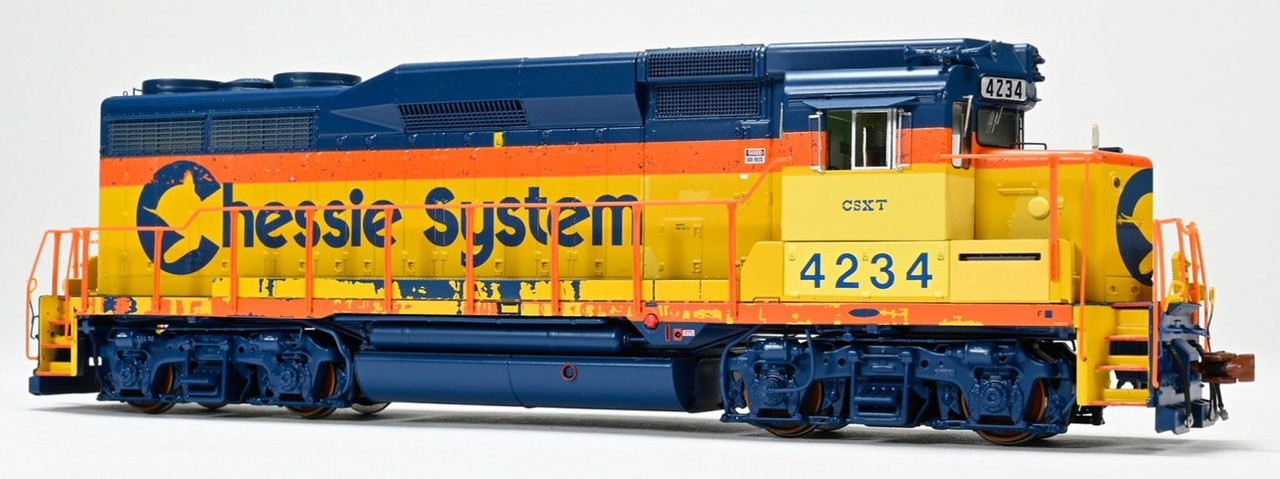
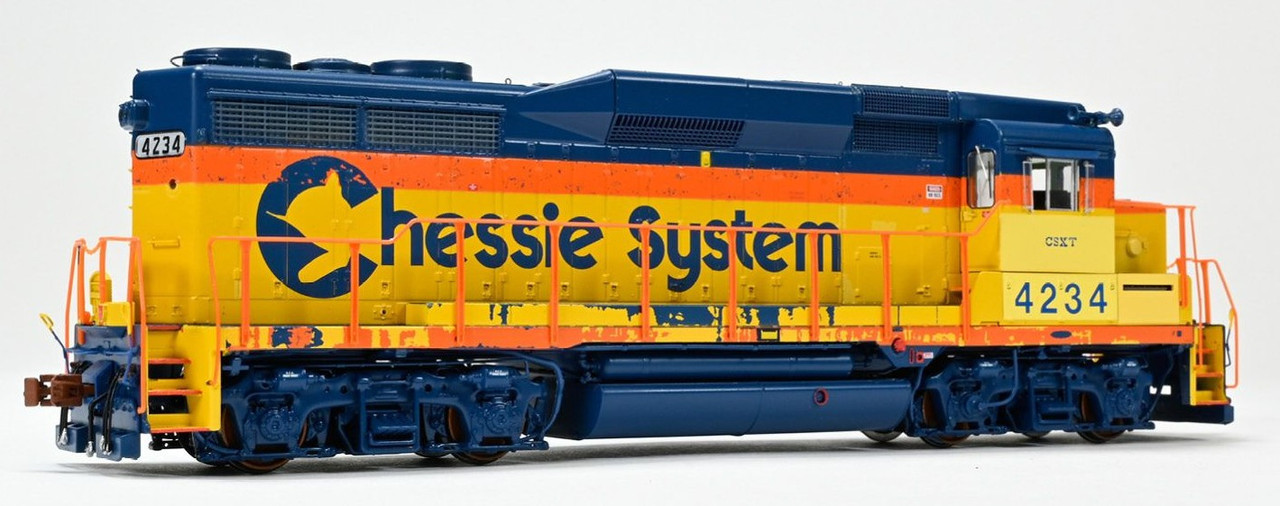
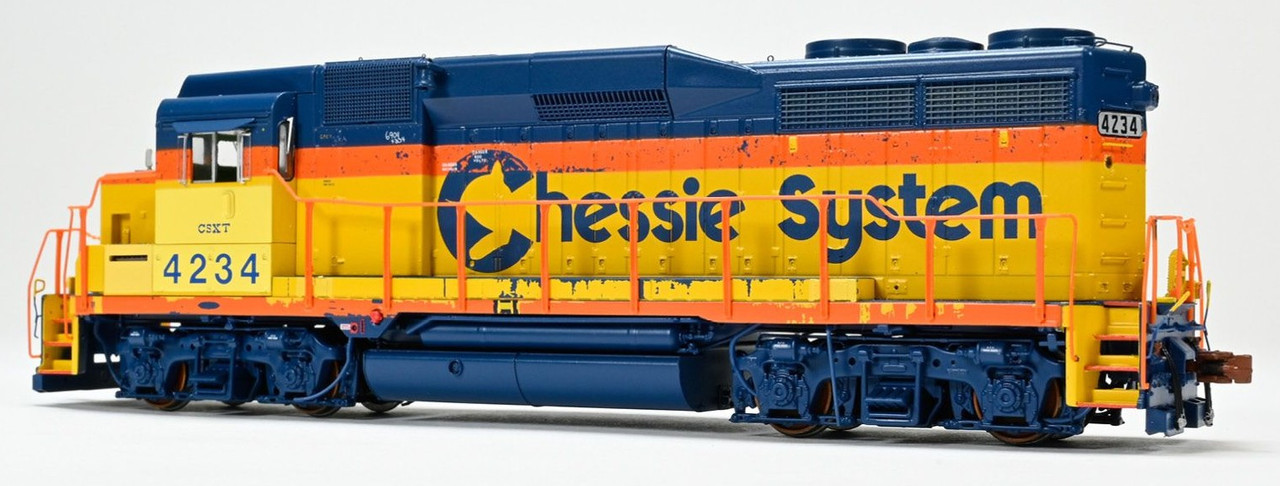
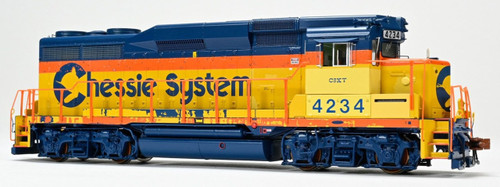
ScaleTrains Rivet Counter HO SXT40962 DCC Ready EMD GP30M CSXT 'ex-Chessie System Patch/Distressed Lettering' CSXT #4244
- In Stock:
- 1
- Scale:
- HO
- SKU:
- SXT40962
Description
Please note picture is representative of the item but may not be same road number. Always refer to product description for actual product details.
ScaleTrains Rivet Counter HO SXT40962 DCC Ready EMD GP30M
CSXT 'ex-Chessie System Patch/Distressed Lettering' CSXT #4244

Road Number Specific ScaleTrains
- New roadname and paint scheme
- Era: 1987 to Mid-1990s
- Series B&O 6904 to 6976
- Series CSXT 4234 to 4266 (ex-B&O)
- Rebuilt 1981-1983
- Fully-assembled
- Multiple road numbers
- Chessie CSXT 4234
-
- Lost-wax brass cast Leslie SU-3L-R horn mounted on right side cab roof eave (alternate chime arrangement)
- Deleted cab heater louvers
- Standard EMD sunshades with long sunshade tracks
- Side-mounted lost-wax brass cast steel bell ahead of the dynamic brake on the fireman’s side
- Rectangular vent on left side of cab
- Round vent on right side of nose
- Bolted Chessie-style “mailslot” battery box doors with battery terminals visible inside
- Chessie CSXT 4244
- Lost-wax brass cast Leslie SU-3L-R horn mounted on right side cab roof eave (alternate chime arrangement)
- Deleted cab heater louvers
- Short sunshade with long sunshade tracks
- Side-mounted lost-wax brass cast steel bell ahead of the dynamic brake on the fireman’s side
- Rectangular vent on left side of cab
- Bolted Chessie-style “mailslot” battery box doors with battery terminals visible inside
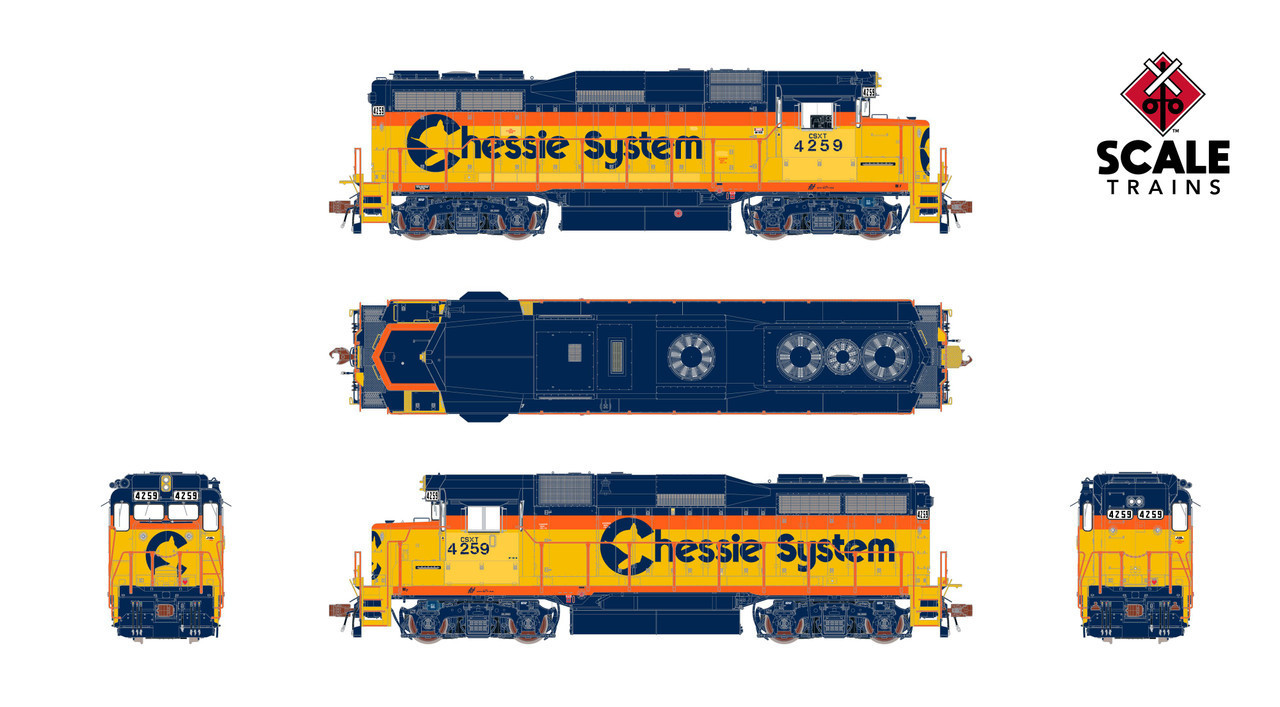
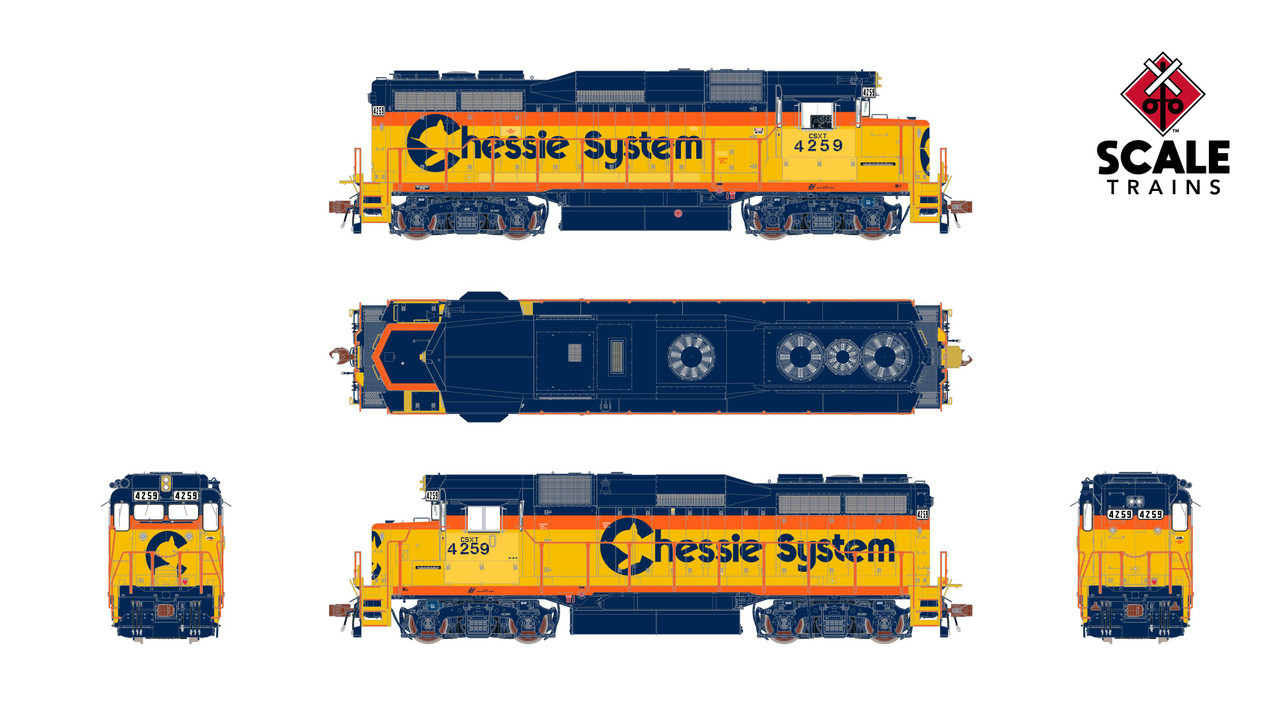
- Chessie CSXT 4259
- Lost-wax brass cast Leslie SU-3L-R horn mounted on right side cab roof eave (alternate chime arrangement)
- Deleted cab heater louvers
- Standard EMD sunshades with long sunshade tracks
- Side-mounted lost-wax brass cast steel bell ahead of the dynamic brake on the fireman’s side
- Rectangular vent on left side of cab
- Bolted Chessie-style “mailslot” battery box doors with battery terminals visible inside
- LED-illuminated ground lights on both sides of locomotive*
- LED-illuminated “hemisphere” walkway lights on hood ends, and at end of raised walkway duct*
- LED-illuminated tricolor front and rear flush-mounted class lights with lenses and raised gaskets**
- LED-illuminated, printed and backlit cab and long hood end number boards
- Front and rear multiple unit (MU) hose catch boxes
- 3-hose multiple unit (MU) hose clusters with silver gladhands
- Semi-scale coupler buffer equipped with durable metal semi-scale Type E knuckle couplers
- Front and rear straight uncoupling levers with retrofitted switchman grab handles
- As-delivered pilot faces without uncoupling lever loop notches
- Deck-mounted multiple unit (MU) receptacle
- Handrail set with center gangway chains
- Front and rear standard drop steps
- Scale sectioned treadplate detail with EMD early “X” style pattern
- 81” GP30 low short hood with ratchet handbrake and square sand fill
- Early cab sub-base doors with early hinges
- Front standard EMD LED-illuminated headlight with lenses on number board housing
- GP30 cab with equal length on both sides
- Detailed cab interior with separate floor, rear wall, seats, and standard AAR control stand
- Sliding cab side windows
- Tall mirrors mounted fore and aft of cab side windows on both sides of cab
- Small “whip” antenna base on forward section of cab roof
- Accurate hood door and long hood detail
- Late single-panel inertial compartment
- Wire inertial air intake grills
- Short turbo exhaust stack
- Standard-range dynamic brakes with 48” fan
- Late See-through dynamic brake intake grills with horizontal wires through vertical vanes
- 6-horizontal rib radiator intake grills
- See-through front and rear 48” radiator fan housings with 8-blade fans; 36” pan-top center radiator fan
- Curved radiator fan grab iron
- Square door-style sand fill door on right side hood end
- Rear LED-illuminated horizontal headlight with lenses
- Underbody frame rail with separate plumbing
- Detailed Blomberg-B trucks with Hyatt bearing housings; elliptical springs; end transom detail; separate sanding lines and brackets; and separate swing hanger detail
- Dimensionally accurate truck centers
- Speed recorder mounted to second axle on right front truck sideframe
- 2,600-gallon fuel tank with vertical gauges and fuel fill in sill skirt; round gauge on right side
- Factory-applied wire grab irons, photoetched lift rings, windshield wipers, trainline hoses with silver gladhands, air tanks, sand hatch covers and more
- Motor with 5-pole skew wound armature
- Dual flywheels
- All-wheel drive
- All-wheel electrical pick-up
- Directional LED-illuminated headlights
- Printing and lettering legible even under magnification
- Operates on Code 70, 83, and 100 rail
- Packaging safely stores model
- Minimum radius: 18”
- Recommended radius: 22”
DCC & sound equipped locomotives also feature:****
- ESU LokSound 5 DCC & Sound decoder with “Full Throttle”
- Two (2) cube-type speakers
- Turbocharged 16-645D3A prime mover sound
- ESU designed “PowerPack” with two super capacitors***
- Operates on both DC and DCC layouts****
DC/DCC & sound-ready locomotives also feature:****
- Operable on DC layouts****
- DCC-ready with 21-pin connector
* Lighting features operate when using an ESU decoder with appropriate programming while operating using DCC
** Class lights illuminate in white color only in DC operation. Access and changing colors requires an ESU decoder with appropriate programming while operating using DCC
***“PowerPack” feature only compatible with appropriately programmed ESU decoders operating on a DCC layout
****Lombard Hobbies Recommendation - As modelers ourselves we highly recommend ONLY running DCC on DCC systems and DC on DC systems, regardless of 'Dual-Mode' capability. This gives optimum performance and safeguards the unit from possible damage from running on a different system than originally intended and from any inexperienced operator errors.
Prototype History:
First introduced in 1961, the GP30 would become one of the most common locomotives on the rails for the next two decades.
The demo unit, numbered 5629, quickly set out to prove its capabilities and features to the railroads. But before long, EMD would re-designate its new general-purpose unit the “GP30”, mainly as a marketing move, the rationale being the model number “30” being greater than the “25” of the competition. They would also tout “30” design features and improvements over previous models. This change, along with a return trip to LaGrange for a new demonstrator paint scheme and some styling tweaks to the carbody that would give it the definitive GP30 “look”, would set the stage for the GP30’s arrival on the railroad scene.
The GP30 would prove to be a winner for EMD, outselling the upstart U25B nearly 2:1, with examples being sold to most major railroads of the era by the time production ended in 1963.
All in all, GP30 would prove to be a success for EMD, helping them hold on to their status as the number one builder in the country, and more importantly, help their railroad customers move freight … and in the case of UP’s GP30Bs, passengers. Most of the various fleets of GP30s across the U.S. and Canada would have long careers, for their original owners, and in many cases, successors due to mergers, bringing even more color to the varied GP30 palette. Various fleets would be distilled down into new owners such as Conrail, Burlington Northern, and Chessie System, as the units toiled on over the years, with many being bumped down into less demanding duties off of the mainline as the years and mileage racked up. One Achilles’ Heel of the GP30 was its complex electrical system, which would give more than one railroad electrician a headache trying to diagnose ground relay faults or other maladies amongst its complex system of relays and switchgear; even its higher-selling successor, the GP35, was to suffer similar issues with its just-as-complex electrical system.
Seeing as the basic design was sound, many railroads would embark on rebuilding programs to try to cure their GP30s of some of those chronic ills. Chessie System would rebuild many members of its inherited B&O/C&O fleet, dubbing the rebuilt units “GP30M”, and was not afraid to send them all over the system on all types of assignments. Some examples of these rebuilds have been documented in run-through service on the Southern Pacific in the 1990s, as far away from home as Southern California, while operating as assets of Chessie successor CSX.
Lombard Hobbies - Your #1 Largest Authorized ScaleTrains Select Retailer!
0 Reviews Hide Reviews Show Reviews
Related Products


ScaleTrains HO
ScaleTrains Rivet Counter HO SXT40964 DCC Ready EMD GP30M CSXT 'ex-Chessie System Patch/Distressed Lettering' CSXT #4259
Please note picture is representative of the item but may not be same road number. Always refer to product description for actual product details. ScaleTrains
ScaleTrains HO
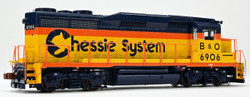
ScaleTrains Rivet Counter HO SXT40957 DCC/ESU Loksound 5 Equipped EMD GP30M Locomotive Chessie System B&O #6939
Please note picture is representative of the item but may not be same road number. Always refer to product description for actual product details. ScaleTrains


ScaleTrains N
ScaleTrains Rivet Counter N SXT39958 DCC Ready EMD GP30 RDMT Road Slug CSX/Stealth “G" Scheme CSXT #2246
ScaleTrains Rivet Counter N SXT39958


ScaleTrains N
ScaleTrains Rivet Counter N SXT39954 DCC Ready EMD GP30 RDMT Road Slug CSX/Stealth “G" Scheme CSXT #2225
ScaleTrains Rivet Counter N SXT39954


ScaleTrains N
ScaleTrains Rivet Counter N SXT39952 DCC Ready EMD GP30 RDMT Road Slug CSX/Stealth “G" Scheme CSXT #2217
ScaleTrains Rivet Counter N SXT39952