

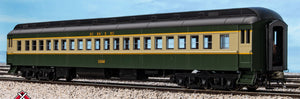

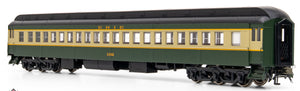

Please note picture is representative of the item but may be different. Always refer to product description for actual product details.
ScaleTrains HO
ScaleTrains Fox Valley Models HO SXT15173 Heavyweight Coach Erie/Two-Tone Green ERIE #1102
Stock: 2
Scale: HO
SKU: SXT15173
ScaleTrains Fox Valley Models HO SXT15173 Heavyweight Coach Erie/Two-Tone Green ERIE #1102
Detailed ScaleTrains
- Erie Railroad
- Era: Early 1950s-early 1960s
- Fully-assembled
- Multiple road numbers on select cars
- Detailed, riveted car bodies
- Flicker-free LED-illuminated lighting
-
LED-illuminated soft overhead interior lighting
- Mimics the gentle glow of period gas lamps
- Flexible end-of-car diaphragms
- Detailed and fully furnished interiors; specific to the prototype
- Detailed underframe specific to the prototype includes brake chains, links, pulleys, rods, dehydrators, air reservoirs, and globe valves
- Factory-applied metal grab irons, coupler cut levers, and trainline hoses with connection pipe and silver gladhands
- Durable body-mounted die-cast metal semi-scale long-shank Type E knuckle couplers, painted a dingy gray/brown color to represent the color of couplers in service
- Free rolling, highly detailed 6-axle trucks
- 36” machined metal wheels with accurately profiled .110" wide wheel tread
- Operates on Code 70, 83, and 100 rail
- Printing and lettering legible even under magnification
- Weighted to Industry standards for reliable operation
- Packaging safely stores the model
- Minimum radius: 22”
-
Recommended radius: 24”
Prototype History:
Originally, many railroad cars were made of wood. This included passenger cars. As train travel increased, larger cars were needed. While wood was a good material to work with, it had limits on the weight it could carry and was not as strong as steel. When steel came around, passenger cars became larger and stronger. The entire car from the frame to the sides and roof was made of metal, usually riveted together. These solid cars were very heavy and needed considerable strength to be pulled. Later, as construction methods like welding were developed and different metals like stainless steel were introduced, railroads found ways to build even stronger cars with lighter weights.
“Heavyweight” often refers to older passenger cars built before the late 1930s. They were usually of riveted steel construction with 6-wheel trucks (not always) and large clerestory or arch roofs that tapered or curved at the ends. Most cars were fully enclosed except for the Observation, which typically had an open porch area on the end. While many different car types were constructed, our cars focus on 5 body styles: Baggage Car, Single Window Coach, Diner, Sleeper, and Observation.
Coach cars were the backbone of passenger trains, providing essential seating accommodations for travelers. Designed with practicality and comfort in mind, these cars offered a more economical option for passengers compared to the luxurious sleeper or dining cars. Coach cars were typically arranged with rows of seats that could accommodate large numbers of passengers, making them ideal for both short and long-distance journeys.
The primary purpose of coach cars was to offer affordable and accessible seating for the average traveler. Unlike sleeper cars, which provided private rooms or bunks, coach cars featured reclining seats that allowed passengers to rest during their journey. While the seating was more basic than in other types of passenger cars, it was still designed to be comfortable, with enough space to relax during the trip.
Coach cars were utilized on almost every passenger train, from local commuter services to cross-country routes like the Pennsylvania Railroad’s "Broadway Limited" and the Atchison, Topeka, and Santa Fe’s "El Capitan." These cars were often the most populated, reflecting their role as the most accessible option for the general public. In addition to seating, some coach cars were equipped with restrooms and luggage racks, further enhancing the convenience for passengers.
While coach cars lacked the opulence of observation, dining, or sleeper cars, they were essential to the operation of passenger trains, providing reliable and comfortable transportation for millions of travelers. Their design emphasized functionality and efficiency, ensuring that passengers could travel long distances at a reasonable cost, making rail travel accessible to a broad segment of the population.
These types of cars could be found all across the US on just about every railroad. Many wore simple “Pullman” green paint schemes, but in later years some cars received new paint to match the then-popular lightweight Streamlined cars. While the lightweight cars took over main duties, heavyweight cars could be found in secondary service, with many extending their lives in later years for MOW crews.
Lombard Hobbies = Big Inventory ∙ Value Pricing ∙ Fast Shipping ∙ Great Service


